
Dr. Panda Train
Dr. PandaEducational
3.713.00 Reviews
- Version
- 26.3.13
- Installs
- 100.00K
- Age Rating
- Everyone
Screenshots
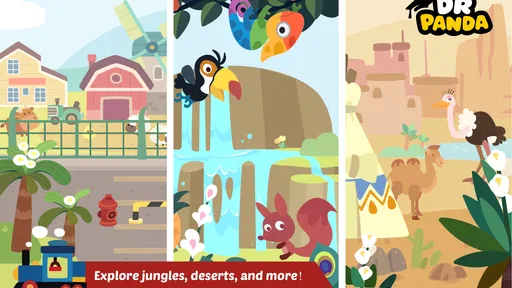
Our Review of Dr. Panda Train
 Analysis by Appyee
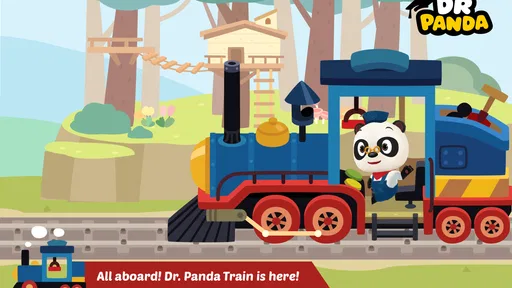
When I first tried Dr. Panda Train, I understood the appeal almost immediately. It puts a young child in charge of a friendly train and turns a familiar journey into a small, hands-on world. You can drive between stops, help passengers, load cargo, and decide what deserves attention next. It feels less like a lesson delivered by an adult and more like a quiet play space where children can experiment at their own pace.
That distinction matters. This is an educational game from Dr. Panda, but it does not lead with quizzes, scores, or obvious exercises. The learning is tucked inside simple routines: noticing who needs help, matching actions to situations, remembering the order of a trip, and understanding that the train has a job to do. I found that approach much more inviting for children who resist anything that looks like homework.
The bigger question is whether the charm survives after the first few rides. My answer is qualified but positive. The game has a strong first week, especially for children who enjoy vehicles and pretend play. Its lasting value depends on whether the child likes replaying familiar activities in different ways. It is not the kind of title I would expect to hold every child’s attention for months without adult involvement, but it can earn a regular place in a younger child’s rotation.
What the first week feels like
The opening appeal comes from control. A child is not merely watching a train move across the screen; the child is involved in making the journey happen. Driving, stopping, helping passengers, and handling cargo give the play session a clear rhythm. That rhythm is easy to understand without a long explanation, which is important when the intended player is still developing reading skills or patience.
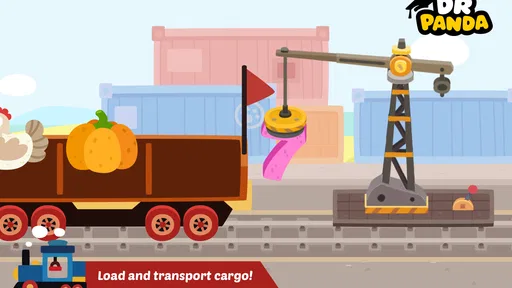
I especially like the way the train provides a reason for each activity. Loading cargo is not presented as an isolated matching task, and helping passengers does not feel like a detached mini-game. Both actions belong to the journey. That context makes the play more memorable than a collection of unrelated taps, because the child can connect cause and effect: the train arrives, people need assistance, goods need handling, and the trip continues.
For a parent, the first session is also refreshingly manageable. I would sit beside a child at the beginning, demonstrate the basic interaction once, and then let the child take over. That creates a useful observation point. You can see whether the child understands the sequence, whether they prefer driving or helping others, and whether they explore freely or wait for instructions.
One practical use is a short transition activity after school or before dinner. A child can complete a small train journey while an adult prepares food, with the adult checking in rather than directing every action. The game’s calm structure suits that moment better than a frantic action title. It gives the child something purposeful to do without demanding the same concentration as a reading exercise.
The train theme also makes the game approachable for children who are fascinated by transport. A child who ignores conventional educational apps may still engage because the immediate motivation is the vehicle itself. In my experience, that is one of its strongest design choices: learning is attached to a subject many young players already find exciting.
There is a useful social angle during the first week too. A parent can ask questions while the child plays: who is waiting, what should happen next, or why does the train need this cargo? These conversations turn a solitary screen activity into shared storytelling. The game does not need to announce a vocabulary lesson for it to encourage sequencing, observation, and simple explanation.
Still, the first-week experience is not equally strong for every child. If a player needs constant novelty, competition, or a visible reward system, the gentle pace may feel too quiet. Children who prefer puzzles with a definite correct answer may also wonder what they are supposed to accomplish. This is open-ended play, and that freedom is a strength only when the child enjoys making choices without being pushed toward a final score.
The age guidance is Everyone, which matches the approachable tone and child-friendly subject. I would nevertheless introduce it with an adult nearby, not because the game feels difficult, but because young children often benefit from help turning free play into meaningful conversation. The title works independently once the controls make sense, yet its educational value is easier to notice when someone occasionally asks the child to describe what they are doing.
Why the routine feels educational without becoming a lesson
The best learning opportunity is the repeated sequence of preparing, moving, stopping, and helping. Children can practice following a chain of events without being told they are practicing. A parent can make this more deliberate by asking the child to predict the next step before tapping. That small pause changes the activity from reaction to planning.
Another useful approach is to let the child narrate the trip. “The passenger is waiting,” “the cargo goes here,” and “the train is leaving” are simple sentences, but they encourage language and order. I would not interrupt every few seconds to correct wording. The game works better when the child owns the story and the adult uses occasional prompts to extend it.
There is also a quiet lesson in responsibility. The player is not only moving a vehicle for fun; the train has passengers and freight that need attention. That makes the role-play more grounded than simply racing from one side of the screen to the other. It gives children a reason to slow down and notice what is happening around them.
What remains after the novelty fades
After the first month, the important issue is replay value rather than discovery. The game does not rely on a traditional campaign that must be completed once. Its value comes from returning to the same train world and finding enjoyment in repeating familiar jobs. For some children, that repetition is exactly what makes it comforting. For others, it will expose the limits of the experience fairly quickly.
I would describe the long-term appeal as role-play value, not endless content value. A child who likes pretending to be a driver, conductor, or helper can revisit the game and create a different story each time. One ride might focus on passengers; another might become a cargo trip; a third might involve the child carefully explaining the whole route to a parent. The actions may be familiar, but the narrative can change.
That makes it a better fit for younger children who enjoy repetition than for older children looking for increasingly difficult challenges. If your child asks for new levels, tougher goals, unlockable rewards, or a clear sense of progression, this probably will not replace a more structured educational game. The experience is intentionally gentle, and gentleness can feel shallow once a player wants mastery.
Its educational category is therefore best understood in a broad sense. I would not choose it as the main tool for teaching spelling, arithmetic, or formal science. I would choose it to support early reasoning, language practice, imaginative play, and the habit of completing a sequence of tasks. That is a worthwhile role, but parents should judge it against that role rather than expecting a digital workbook.
There is a useful month-to-month routine here if you keep sessions purposeful. Instead of handing over the device with no context every time, you might set a small challenge: describe the journey, remember the order of two tasks, or explain why a passenger needs help. The challenge should stay conversational rather than becoming a test. This keeps repeat play from turning into automatic tapping.
One non-obvious strength is that the game can work as a bridge between screen play and real-world observation. After a session, I could ask a child to notice trains, buses, delivery vehicles, or passengers during an outing. The digital journey gives the child a vocabulary for talking about movement and service. That connection is more valuable than another uninterrupted screen session because it helps the play travel beyond the device.
On the other hand, the game is not ideal for a household that wants one app to serve several age groups. A younger child may enjoy the freedom, while an older sibling may finish exploring the central idea and move on. The educational design is focused rather than broad. That focus keeps the experience accessible, but it limits how long it can remain equally interesting across different developmental stages.
How it compares with more conventional educational games
Compared with flashcard apps, this game is less direct. It will not give a parent a neat record of correct answers or make academic progress obvious. Its advantage is that children may stay engaged longer because the learning is embedded in play. If your main goal is practicing a specific school skill, a dedicated learning app is likely the better choice.
Compared with racing games, it is slower and more thoughtful. There is less pressure to react quickly, and the emphasis is on managing a journey rather than winning one. That makes it a better option for a child who becomes frustrated by competition, but a weaker option for a child who needs excitement to remain interested.
Compared with open-ended toy or sandbox apps, the train gives the child more structure. There is a recognizable purpose behind the interactions, so the player is not starting with a completely blank world. At the same time, it does not appear to force every session into one narrow solution. That middle ground is where the game is most comfortable.
The trade-off is clear: you exchange measurable progression for replayable pretend play. I consider that a fair exchange for the right child, especially when the adult wants a calmer activity. I would not make the purchase expecting a complete curriculum, a deep simulation, or a game that continually expands its challenge.
Maintenance, friction, and reasons children may tire of it
The maintenance burden is fairly low in terms of attention, but it still needs a little parental management. The game is simple enough for a child to learn, yet simple games can become background noise if they are always available without a purpose. I would keep it as one option among several activities rather than making it the default response to boredom.
A good routine is to let the child choose the focus of each session. One day, the goal can be helping passengers; another day, it can be handling cargo carefully. This gives repeated play a small sense of intention without pretending that the game has a large progression system. It also helps an adult notice when the child is genuinely engaged and when they are merely tapping through habit.
Because the game is designed around a familiar train routine, fatigue may arrive in predictable ways. A child may enjoy driving but lose interest when the same responsibilities begin to feel familiar. Another child may spend every session on the vehicle and ignore the social or organizational side. That is not necessarily a problem, but it means the parent may need to invite broader play rather than assuming every part will receive equal attention.
Some children may also find the lack of pressure confusing. In many educational games, a correct answer produces a reward and an incorrect answer signals what to try again. Here, the satisfaction comes from interaction and pretend responsibility. If your child asks, “What do I win?” the honest answer is that the reward is the journey itself. That works beautifully for imaginative players and poorly for children motivated mainly by achievement markers.
Another limitation is the possibility of adult over-direction. It is tempting to tell a child exactly where to tap, especially when the child pauses. Doing that can turn a playful activity into a demonstration controlled by the parent. I found it better to wait, offer one question, and allow the child to make a choice. The game’s open structure is most useful when the child is allowed to make harmless mistakes and try again.
For families concerned about value, the purchase price is $3.99. I see that as reasonable when the child already enjoys train-themed play and will return to an open-ended activity. It is harder to justify if the child usually abandons a game after discovering its central interaction. The decision should depend less on the number of listed features and more on whether repetition is a positive part of your child’s play style.
The technical requirements are also worth checking before installing. The current version is 26.3.13 and requires Android 7.0 or later. That makes compatibility a straightforward question for an older device: check the operating system first, then consider whether the child’s interests match the game. I would not treat an update number as a reason to buy, but it is useful when maintaining a family tablet.
Dr. Panda has built the title for a broad audience, and its reach reflects that: it has passed 100K installs. The average rating is 3.7 from 435 ratings, with 13 written reviews. I read that as a sign of a product that appeals strongly to some families while leaving others wanting more depth, which matches my own impression. It is neither a universal favorite nor an obvious miss.
Who should keep it installed
I would recommend keeping it available for a preschool or early-primary child who likes vehicles, pretend jobs, and repeating familiar routines. It is particularly suitable for quiet independent play with occasional adult conversation. It can also be useful during travel or waiting periods when a child needs an activity that is more engaging than a passive video but less demanding than a competitive game.
I would be more cautious for children who need explicit academic practice. If the family’s priority is counting, phonics, handwriting, or progress tracking, another educational title should take the lead. This game can complement those tools, but it should not be mistaken for a replacement.
I would also skip it for a child who quickly becomes restless with repeated interactions or who expects constant new content. The train’s appeal depends on the pleasure of returning to a known world. That is a meaningful design choice, not a flaw by itself, but it makes the audience narrower than the Everyone label might suggest.
My long-term verdict
After the novelty fades, Dr. Panda Train earns its space when a child treats play as storytelling rather than as a race toward completion. I like its clear theme, its gentle pace, and the way passenger care and cargo handling give purpose to simple actions. The most valuable moments are not the taps themselves, but the planning, narration, and responsibility an adult can draw out of them.
Its weaknesses are equally clear. The experience may feel limited to children who want stronger challenges, visible progress, or academic targets. Repetition is central, so long-term value depends on the player’s temperament. Parents also need to resist turning a free-play game into a tightly managed exercise, because too much instruction removes much of what makes the title appealing.
For me, this is a good focused purchase rather than an essential all-purpose learning app. The developer, Dr. Panda, has made something that can support imaginative and early educational play without becoming noisy or demanding. I would recommend it to a child who already loves trains and enjoys taking on small roles. I would pass if the goal is measurable school practice or a constantly changing challenge.
The best way to use it is in short, intentional sessions: let the child choose the journey, ask one or two questions, and occasionally connect the train’s jobs with real life. Used that way, it can remain useful beyond the first burst of excitement. It may not become a daily favorite for every child, but for the right player, it offers a dependable little world that is calm, understandable, and worth revisiting.
Verdict
Strengths of Dr. Panda Train
- Simple controls make it easy for young children to start playing.
- Bright, friendly visuals are appealing without being overwhelming.
- Open-ended play encourages children to create their own train journeys.
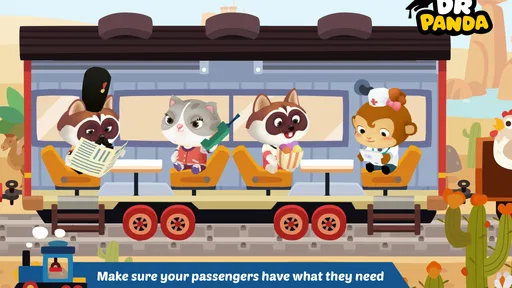
- Different passenger interactions add variety to each trip.
- Works well as a calm, low-pressure activity for preschoolers.
Limitations of Dr. Panda Train
- Gameplay may feel repetitive after children discover the main interactions.
- Limited challenge means older children could lose interest quickly.
- Some features may be restricted depending on the app version.
- Requires enough storage space for installation and updates.
- Parents may want more educational guidance or progress tracking.
Other Releases by Dr. Panda
View All
Dr. Panda Restaurant
Educational3.9

Dr. Panda Restaurant 2
Educational4.1

Dr. Panda Bath Time
Educational3.8

Dr. Panda Racers
Racing3.9
Similar Picks in This Category
View All
Little Panda Policeman
BabyBus4.0

Monster Trucks Game for Kids 2
Raz Games4.1

Little Panda's Chinese Recipes
BabyBus4.4

Little Panda's Restaurant
BabyBus4.4

Little Panda's Ice Cream Games
BabyBus4.3

Baby Panda Care
BabyBus3.8
Frequently Asked Questions
What is Dr. Panda Train, and what can children do in the game?
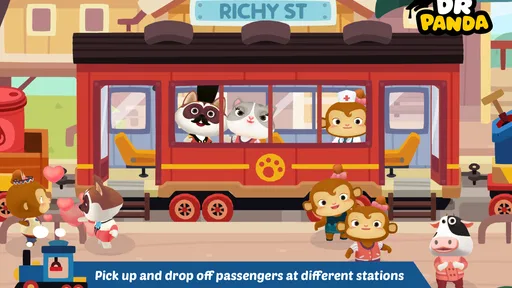
Dr. Panda Train is a child-friendly interactive game in which children take control of a colorful train and explore different locations with animal passengers. Players can choose where the train travels, interact with characters, load items, and discover simple activities along the route. The experience is designed around open-ended play rather than strict objectives, allowing children to create their own stories at a relaxed pace.
Is Dr. Panda Train suitable for young children?
The game is generally aimed at preschool and early-school-age children, with simple controls and an interface that is easy to understand without advanced reading skills. There are no complicated missions, fast reactions, or difficult puzzles to complete. Younger children may still benefit from occasional help when first learning the controls, while parents should check the store listing for the current age recommendation on their device.
Does Dr. Panda Train require an internet connection to play?
Dr. Panda Train is primarily designed as an offline-friendly experience after installation, which makes it convenient for travel, waiting rooms, or areas without reliable Wi-Fi. Some platform features, such as downloading the game, restoring purchases, receiving updates, or accessing store services, may require an internet connection. Availability of offline play can vary by device version, so it is worth confirming the current listing before downloading.
Are there advertisements or in-app purchases in Dr. Panda Train?
One of the main advantages of Dr. Panda Train is its child-focused design, which avoids the aggressive advertising and competitive monetization often found in mobile games. However, purchase details can differ depending on the version, operating system, region, or store listing. Parents should review the Google Play or App Store information before installation and use device-level purchase restrictions if children have access to the device.
Is Dr. Panda Train worth downloading for children?
Dr. Panda Train is a good choice for families looking for a calm, creative game that encourages exploration and pretend play instead of competition. Its strongest qualities are the colorful presentation, approachable controls, and freedom to interact with the train world at the child’s own pace. It may feel limited to older children who want complex challenges, but it works well as a safe, simple entertainment option for younger players.
Play our best games!


